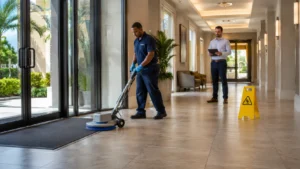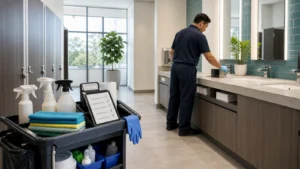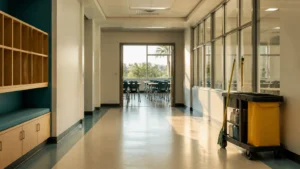

A janitorial task restores an approved area through cleaning, waste removal, restocking, or scheduled floor care. A maintenance issue may require repair, replacement, technical attention, or another authorized trade. When the boundary is unclear, document and route the condition—do not guess.
Quick answer: A janitorial task restores an approved area through cleaning, waste removal, restocking, or scheduled floor care. A maintenance issue involves a condition that may need repair, technical attention, replacement, or another authorized trade. When the boundary is unclear, document the condition, protect the area if necessary, and route it to the property’s designated contact instead of assuming who should fix it.
Condominium and HOA common areas generate many small observations: debris near an entrance, an empty soap dispenser, a loose handle, a light that is out, water near a restroom fixture, or a mark on a lobby wall. The useful question is not simply, “Who saw it?” It is, “What type of action does this condition require, and who is authorized to assign it?”
This guide helps community association managers, property managers, board representatives, facility teams, and cleaning providers separate routine common-area janitorial work from maintenance issues. It is an operational planning framework—not legal advice and not a substitute for the association’s governing documents, management agreement, vendor scope, or emergency procedures.
Start with the condition, not the department
Before assigning a task, describe what is actually visible. A note such as “the restroom needs attention” could mean several different things:
- the floor needs to be cleaned;
- a liner or approved consumable needs to be replaced;
- a dispenser is empty because supplies are unavailable;
- a dispenser is damaged and may need repair;
- water is present because of an active leak;
- access was blocked when the scheduled cleaning visit occurred.
Those conditions should not all become the same janitorial complaint. A clear description helps management route the issue correctly and prevents the cleaning scope from expanding through assumptions.
Use three practical classifications
1. Janitorial task
The condition can be addressed through a cleaning, restocking, waste, or floor-care task already listed in the approved scope. Examples may include vacuuming visible debris, cleaning an approved glass surface, emptying a designated receptacle, or restocking an approved dispenser when supplies and responsibility are confirmed.
2. Maintenance issue
The condition may require repair, replacement, troubleshooting, technical work, or another qualified service. A broken fixture, damaged door component, active leak, failed light, or equipment problem should not be relabeled as a missed cleaning task merely because a cleaner noticed it.
3. Scope or responsibility decision
The condition cannot be assigned until management checks the written scope, supply responsibility, access instructions, or approval process. This category is useful when a surface was blocked, a room was locked, consumables were unavailable, or a new task is being requested.
Common-area examples: clean, report, or clarify
| Observable condition | Likely first classification | Next step to document |
|---|---|---|
| Sand, leaves, or visible debris near an approved entrance | Janitorial task | Confirm the area, service window, and applicable checklist item. |
| Water on the floor with no known source | Protect and escalate | Follow the property’s immediate safety and reporting procedure; do not assume it is only a mopping task. |
| Soap dispenser is empty and approved refills are available | Janitorial or restocking task, if included | Confirm the restocking responsibility and record completion. |
| Soap dispenser is cracked, loose, or not operating | Maintenance issue | Report the fixture condition to the designated contact. |
| Elevator cab has fingerprints or visible floor soil | Janitorial task, if the cab is included | Confirm access, approved surfaces, and frequency. |
| Elevator button, door, or operating component appears damaged | Maintenance issue | Route the observation through building management; do not attempt a repair. |
| Lobby light is out | Maintenance issue | Record the location and notify the designated contact. |
| A wall mark can be removed with an approved cleaning method | Janitorial task, if included | Follow the approved surface method and report any remaining damage. |
| A wall has peeling paint, impact damage, or moisture staining | Maintenance issue or management review | Document the condition without diagnosing the cause. |
| A locked amenity room could not be serviced | Access or scope decision | Record the blocked area and follow the approved escalation path. |
The table is a routing aid, not a universal contract. The property’s approved scope and procedures determine the final responsibility.
Apply the distinction by area
Entrances, lobbies, and corridors
Routine common-area cleaning may cover mats, approved floors, interior glass, touchpoints, receptacles, and visible litter. Damaged flooring, loose transition strips, broken door hardware, failed lighting, or an active source of water belongs in the property’s maintenance or safety process.
Because entrances in Fort Lauderdale and across Broward County can receive changing traffic and weather exposure, the plan should identify the service window, approved floor method, mat responsibility, and the contact who handles a condition that cleaning cannot resolve.
Shared restrooms
The written scope should separate cleaning and restocking from fixture repair and plumbing. A restroom checklist can identify fixtures and surfaces to clean, consumables to check, supply ownership, condition checks, and the reporting path for leaks, damage, clogs, or unavailable inventory.
For a detailed cleaning framework, use the commercial restroom cleaning checklist. It supports the classification process without turning a repair condition into a janitorial task.
Elevators and stairwells
Cleaning can cover approved cab surfaces, tracks that are safe and accessible, mirrors, handrails, doors, floors, and landings when those tasks are in scope. Mechanical operation, damaged controls, door faults, emergency equipment, and technical inspections belong to the appropriate building process or qualified provider.
Clubhouses, fitness rooms, and amenity spaces
The condominium and HOA cleaning service can define cleaning for approved shared spaces. Equipment operation, repairs, calibration, specialized servicing, resident property, and conditions outside the approved cleaning method should be routed separately.
Trash rooms and collection points
The scope should identify which receptacles, liners, collection points, and floor areas are included. Broken compactors, damaged doors, pest concerns, drainage problems, or collection-provider issues require a different owner. The cleaning team can report an observable condition without diagnosing or repairing equipment.
Build one clear reporting path
A useful issue report does not need to be long. It should answer:
- Where is the condition? Building, floor, room, or common-area location.
- What is observable? Describe what can be seen without diagnosing a cause.
- When was it observed? Include the date and approximate time.
- Was the area protected? Note signage or other approved immediate action when applicable.
- How was it classified? Janitorial, maintenance, supply/access, or management review.
- Who owns the next step? Name the designated role or contact.
- When will it be checked again? Add a due time or review point when the property’s process requires one.
Photos may help when the property permits them, but they should avoid residents, private documents, access codes, license plates, screens, or other sensitive information.
What the cleaning team should report—not automatically repair
A recurring cleaning team may be well positioned to notice conditions because it follows the same route regularly. Observation does not automatically authorize repair. The written plan should explain how to report:
- active water, unusual moisture, or a recurring wet area;
- damaged dispensers, doors, handles, railings, or fixtures;
- failed or flickering lights;
- loose floor transitions, damaged flooring, or other visible trip concerns;
- blocked exits or access points;
- unavailable supplies that prevent an approved task;
- locked areas that were scheduled for service;
- visible conditions that remain after the approved cleaning method was completed.
Management should define the emergency path separately from routine issue reporting. The article does not replace that property-specific procedure.
Keep change requests out of informal messages
A request can begin as a simple observation and then become new recurring work. For example, a board may ask the cleaning team to add another amenity room, increase an entry frequency, restock a new product, or monitor a collection area that was not included before.
The designated management contact should approve changes to areas, tasks, frequency, access, or service windows in writing. Changes that affect price or commercial terms also require Osorio’s internal approval before they become part of the service. This protects both the property and the service team from relying on different versions of the plan.
For multi-area or multi-property programs, review the property management janitorial service to align scopes and reporting across locations.
Avoid five common routing mistakes
- Calling every visible condition a cleaning failure. Check whether the issue is a repair, access problem, supply blocker, traffic condition, or new request.
- Asking cleaners to diagnose equipment or building systems. Record the observation and route it to the qualified owner.
- Adding recurring tasks through texts or hallway conversations. Use the approved change process.
- Sending the same issue to several people without one owner. Assign one contact and one status.
- Closing the ticket without verification. Recheck the area or obtain the property’s required completion record.
If the question is specifically about service quality, the commercial cleaning quality inspection checklist explains how to separate a missed task from a frequency, access, supply, or scope issue.
Questions to settle during the walkthrough
Before recurring service begins, the property and provider should confirm:
- which common areas and tasks are included;
- which conditions require immediate escalation;
- who provides and stores approved consumables;
- which rooms, equipment, records, or resident areas are restricted;
- who receives routine janitorial issues;
- who receives maintenance observations;
- who may approve a scope, frequency, access, or schedule change;
- whether photos are permitted and what must remain private;
- how blocked access and incomplete tasks are recorded;
- how management verifies that an issue is closed.
The resulting checklist should match the actual property. A recurring janitorial service can then follow the approved areas and frequencies while management retains a clear path for conditions outside that scope.
Fort Lauderdale and Broward condo/HOA planning
The same routing principle can support condominium towers, HOA clubhouses, mixed-use properties, and managed communities throughout Fort Lauderdale and Broward County. The exact plan still depends on the building, common elements, amenities, operating hours, resident traffic, vendor responsibilities, and the association’s own approvals.
Miami-Dade is a confirmed secondary service area, but this guide does not assume that every property has the same access, staffing, maintenance, or board process.
Turn common-area observations into a clear next step
If your condominium, HOA, or managed property needs recurring common-area cleaning, Osorio can review the approved spaces, cleaning tasks, access requirements, supply responsibilities, and reporting path during a walkthrough. The goal is a scope that tells everyone what belongs to routine janitorial service and how to route conditions that require another decision.
Request a walkthrough to discuss a written cleaning plan for your property.
Clear answers for condo and HOA teams
Every answer remains in the rendered HTML and matches the proposed FAQ schema exactly.
What is the main difference between janitorial cleaning and property maintenance?
Janitorial cleaning restores approved areas through tasks such as surface cleaning, waste removal, restocking, and scheduled floor care. Property maintenance addresses conditions that may require repair, replacement, troubleshooting, technical work, or another authorized service. The written scope determines the final boundary.
Does a janitorial company repair broken fixtures in a condo or HOA?
Not automatically. A cleaning team can report a broken or loose fixture, but repair should be assigned only when that work is separately confirmed, authorized, and within the provider’s approved scope. Otherwise, route it to the property’s maintenance contact or qualified vendor.
Is water on a restroom floor a cleaning issue or a maintenance issue?
It depends on the source. A contained spill may be a janitorial response when included, while recurring or unexplained water may indicate a leak or fixture problem. Protect the area and follow the property’s escalation procedure instead of assuming that mopping alone resolves it.
Who is responsible for restroom soap, paper products, and liners?
The scope should name who purchases, stores, monitors, and restocks each consumable. An empty dispenser may be a missed restocking task, a supply shortage, an access problem, or a damaged fixture, so management should confirm the actual condition before assigning responsibility.
Can a day porter report maintenance issues in common areas?
Yes, when observation and issue reporting are part of the approved role. A day porter can document and route a visible condition through the designated channel, but that does not automatically authorize technical diagnosis or repair.
How should a cleaning team report a maintenance concern?
Record the location, date and time, observable condition, any approved immediate safety step, and the person notified. Avoid diagnosing the cause, exposing private information, or promising a repair time that has not been authorized.
Who can approve a change to a condominium cleaning scope?
The property should name a designated management or board-authorized contact who can approve changes to areas, tasks, frequency, access, or service windows in writing. Changes that affect price or commercial terms also require the cleaning company’s authorized internal approval.
How can a property avoid duplicate cleaning and maintenance tickets?
Use one reporting channel, one owner, a clear classification, and a visible status for each condition. The record should show who is taking the next step and how completion will be verified, rather than sending the same observation to several vendors.
Can one company provide both janitorial cleaning and property maintenance?
A company may offer both, but the services should still be defined separately. Each task needs an approved scope, responsible contact, access requirement, and authorization. Do not assume that a cleaning agreement includes repair work—or that a maintenance agreement includes recurring cleaning.
Do these guidelines apply to Fort Lauderdale and Broward County properties?
Yes. They provide a practical framework for Fort Lauderdale and Broward condominium, HOA, mixed-use, and managed properties. The final responsibilities must still match the specific building, governing documents, management process, vendor agreements, and emergency procedures.
Define the cleaning scope and the reporting path
Review approved common areas, access, supply responsibilities, change authorization, and issue routing during a walkthrough.