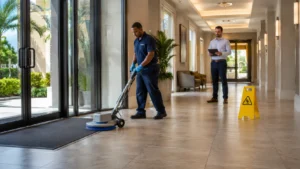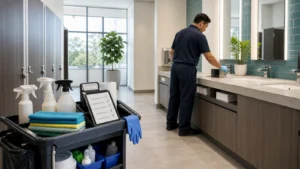

The right office cleaning frequency depends on how the workplace is used—not on a universal daily, weekly, or monthly rule. Start with occupancy, visitor traffic, restroom and breakroom use, floor types, operating hours, access, and the condition expected when employees or customers arrive. Then assign a frequency to each zone instead of forcing the whole office onto one schedule.
For offices in Fort Lauderdale and across Broward County, a walkthrough can turn those facts into a written plan. If the goal is recurring service rather than a do-it-yourself checklist, review our office cleaning services before comparing schedule options.
Why one frequency rarely fits the entire office
An office is a group of spaces with different traffic and cleaning needs. The entrance may collect visible soil during wet weather. Restrooms and breakrooms can change quickly as occupancy rises. A quiet private office may need less frequent attention than a reception area, conference room, copy station, or shared kitchen.
That is why “clean the office three times a week” is incomplete. A usable plan should answer three separate questions:
- Which tasks happen on every service visit?
- Which detail tasks rotate weekly or on another agreed cycle?
- Which floor, upholstery, glass, or deep-cleaning tasks are periodic and approved separately?
This structure helps the service match the facility while keeping the scope clear enough to inspect.
Seven factors that should set office cleaning frequency
1. Occupancy and visitor traffic
More people usually create more trash, restroom use, fingerprints, floor soil, and demand on shared areas. Count regular employees, hybrid attendance patterns, vendors, clients, and visitors—not just square footage.
2. Restroom and breakroom use
These rooms often need a different frequency from private offices. The plan should consider the number of users, supply consumption, meal activity, spills, odors, and the condition expected throughout the workday.
3. Public-facing areas
Reception desks, entrances, conference rooms, glass doors, and waiting areas affect the first impression of the workplace. A quiet back office and a client-facing lobby should not automatically receive the same priority.
4. Floor type and tracked-in soil
Carpet, tile, resilient flooring, mats, and specialty surfaces require different methods. Entry conditions, deliveries, rolling chairs, and heavy paths can also change how often vacuuming, mopping, spot work, or periodic floor care is needed.
5. Operating hours and access
Cleaning may need to happen before opening, after closing, overnight, or on weekends. Keys, fobs, alarms, locked rooms, occupied workstations, and noise restrictions can affect what the crew can complete during each visit.
6. Responsibility boundaries
The janitorial company should not have to guess whether employees clear desks, management orders consumables, or cleaners reset shared areas. Define those boundaries before selecting frequency. Our office cleaning responsibility matrix helps separate staff, management, and provider duties.
7. Quality records and recurring issues
Issue logs, inspection notes, supply shortages, repeat complaints, and missed-access records show whether the schedule is working. A plan should be adjusted from documented patterns, not from one vague comment or an arbitrary calendar.
Office cleaning frequency matrix by area
Use this matrix as a walkthrough tool. It is not a fixed service promise; the final frequency should reflect the facility and agreed scope.
| Office zone | What to observe | Frequency decision |
|---|---|---|
| Entrance and reception | Foot traffic, mats, glass, visible floor soil, deliveries | Include on each relevant visit; increase attention when traffic or conditions create faster buildup |
| Restrooms | User volume, fixture condition, odors, dispensers, trash | Set cleaning and restocking frequency around actual use and the condition required during operating hours |
| Breakroom or kitchen | Meals, spills, sinks, counters, appliance exteriors, waste | Match service to meal activity and clarify what employees reset between visits |
| Workstations and private offices | Occupancy, clutter, privacy, approved touchpoints | Define what can be moved or wiped and schedule only the surfaces included in the scope |
| Conference and training rooms | Booking volume, food service, fingerprints, floor traffic | Coordinate resets with room use rather than treating every room identically |
| Copy and shared-equipment areas | Paper debris, touchpoints, bins, supply ownership | Include routine attention and define who manages equipment and consumables |
| Carpet and hard floors | Material, traffic lanes, spots, moisture, finish condition | Separate routine vacuuming or mopping from periodic extraction, detail work, or finish care |
| Interior glass and partitions | Fingerprints, public visibility, height and access | Set a routine for visible touchpoints and a separate cycle for broader glass detail |
How to build a practical office cleaning schedule
Step 1: Walk the office while it is in normal use
A vacant building can hide the real traffic pattern. Note busy entrances, restrooms, breakrooms, meeting areas, trash points, and spaces that become difficult to access during working hours.
Step 2: Define the required condition by zone
“Clean” is too broad to inspect. Describe the expected condition: trash removed, dispensers restocked, floors free of visible debris, counters wiped, glass free of fingerprints, or conference rooms reset when included.
Step 3: Separate routine, rotating, and periodic work
Routine work supports the condition expected after each visit. Rotating work covers details that do not need attention every time. Periodic work should be scheduled separately so it does not disappear inside a vague recurring scope.
Step 4: Confirm access, supplies, and communication
Document service windows, keys or fobs, alarm procedures, restricted rooms, supply ownership, and the person authorized to approve changes. A missed area caused by blocked access should not be recorded the same way as a missed task.
Step 5: Review evidence and adjust one variable at a time
Use inspection notes and issue reports to decide whether the problem is frequency, scope, access, supplies, or execution. Our commercial cleaning quality inspection checklist provides a practical way to classify and follow up on those issues.
Signs the current schedule may need adjustment
The following patterns can indicate that the office has outgrown its schedule or that the scope needs clarification:
- Restroom supplies repeatedly run low before the next visit.
- Trash, recycling, or breakroom waste reaches capacity too early.
- Entry floors or mats show visible buildup during normal operating hours.
- The same conference room, glass door, or shared area generates repeated complaints.
- Cleaners regularly cannot enter locked rooms or complete work within the service window.
- Employees and the cleaning crew duplicate tasks—or assume the other party owns them.
- Periodic floor or detail work is requested only after the condition becomes disruptive.
- Inspection notes show the same issue without a named owner or follow-up date.
More visits are not always the answer. A clearer scope, different route, better access, adjusted supply responsibility, or a targeted increase in one zone may solve the problem with less disruption.
What should be written into the office cleaning scope?
Before approving recurring service, the written scope should identify:
- included rooms and excluded areas;
- tasks assigned to each area;
- frequency for routine, rotating, and periodic work;
- service days and access window;
- keys, fobs, alarms, and locked-room procedures;
- responsibility for liners, paper goods, soap, products, and equipment;
- inspection method and issue-reporting contact;
- process for approving a change in scope or frequency.
Use the office cleaning contract checklist when those operational details need to be compared across proposals.
How frequency affects pricing without using a generic rate
Frequency is only one pricing factor. The estimate can also change with facility size and layout, restroom and breakroom count, floor materials, traffic, access time, security procedures, supply responsibility, specialty work, and the condition required after each visit.
Two offices of similar size may need different plans because one receives customers all day while the other has light hybrid occupancy. A walkthrough gives the provider enough information to price the agreed scope instead of relying on a rate that ignores how the office operates.
Planning for offices in Fort Lauderdale and Broward County
South Florida offices can include street-level suites, multi-tenant buildings, professional practices, administrative workplaces, and properties managed as part of a larger portfolio. The schedule should reflect each location’s traffic, building access, service window, and shared-area responsibilities.
Osorio Cleaning & Maintenance Services provides recurring office cleaning in Fort Lauderdale and throughout Broward County, with Miami-Dade County as an additional confirmed service area. The company can review the space, discuss priorities, and prepare a written scope for consideration.
Frequently asked questions
How often should an office be professionally cleaned?
There is no single frequency for every office. Busy, public-facing workplaces may need daily or several-times-weekly service, while a smaller, low-occupancy office may use a lighter schedule. The best plan assigns frequency by zone after reviewing traffic, restrooms, breakrooms, floors, access, and the condition expected after service.
Is square footage enough to choose an office cleaning schedule?
No. Square footage helps estimate the amount of space, but occupancy, visitor traffic, room use, floor type, restroom demand, access, and task complexity can matter just as much. A small busy office can require more frequent attention than a larger quiet one.
Which office areas usually need the most frequent attention?
Entrances, restrooms, breakrooms, reception areas, shared equipment, trash points, and frequently touched surfaces often change fastest. The exact priority depends on how the office operates and which areas are included in the written scope.
Should restrooms and breakrooms follow the same frequency as private offices?
Not automatically. Restrooms and breakrooms usually have different traffic, waste, supply, and spill patterns from private offices. They should be evaluated separately and given a frequency that matches actual use.
Can office cleaning be scheduled after business hours?
Yes. Osorio offers day, evening, overnight, and weekend scheduling options. The final service window depends on the office’s operating hours, access procedures, alarm requirements, and agreed scope.
What should employees handle between professional cleaning visits?
That depends on workplace policy. Employees may be responsible for personal items, confidential papers, food, and simple resets, while management and the janitorial provider handle different shared responsibilities. These boundaries should be written into the scope.
How do floor types affect cleaning frequency?
Carpet, tile, resilient flooring, mats, and specialty surfaces collect and show soil differently. Traffic lanes, weather, deliveries, rolling chairs, and the required appearance can affect routine care and the timing of periodic floor work.
Who supplies soap, paper products, liners, and cleaning products?
The parties should decide that before service begins. The written scope should identify who purchases, stores, monitors, and restocks each item so shortages are not mistaken for a cleaning failure.
What can cause office cleaning prices to change?
Pricing can change with facility size and layout, visit frequency, included tasks, restroom and breakroom count, floor types, access, security requirements, supplies, periodic work, and the starting condition. A walkthrough supports a quote based on the actual scope.
Can an office cleaning schedule be adjusted after service starts?
Yes. The schedule can be reviewed when occupancy, operating hours, traffic, room use, access, or quality records change. Document the reason, the affected zone, the proposed adjustment, and how the result will be checked.
Build the schedule around the way your office works
A useful office cleaning schedule makes the scope easier to understand, inspect, and adjust. It should protect high-use areas without over-servicing quiet spaces and should identify who owns access, supplies, reporting, and periodic work.
If your Fort Lauderdale or Broward County office needs a recurring plan, request a walkthrough to review the facility and prepare a written scope. Miami-Dade County service can also be discussed based on the property and scheduling needs.