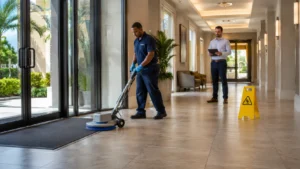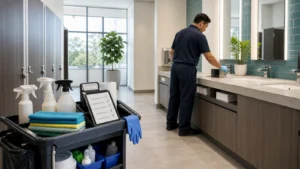

When several commercial cleaning proposals arrive with different prices, formats, and service descriptions, the lowest number can look like the simplest choice. But a lower quote is not necessarily a better value—and a higher quote is not automatically more complete.
The real question is whether the proposals describe the same work.
For office managers, facility managers, and commercial property owners in Broward County, an effective comparison should show what each provider will clean, how often the work will be completed, how service concerns will be handled, and which costs or tasks remain outside the recurring price. A proposal that makes those details clear is easier to manage after service begins.
This guide provides a practical way to compare commercial cleaning proposals without turning the decision into a price-only contest.
Normalize the scope before comparing the price
Two proposals cannot be compared fairly when they cover different areas or tasks. One company may quote restrooms, offices, reception areas, and the break room, while another may also include interior glass, detailed dusting, or common corridors.
Start by creating one list of the areas and outcomes the property actually needs. Then check every proposal against that same list.
Common scope categories include:
- Entrances, reception areas, and lobbies
- Private offices and open work areas
- Conference and meeting rooms
- Restrooms and handwashing areas
- Break rooms and staff areas
- Accessible floors, baseboards, and interior glass
- Elevators, corridors, stairwells, or shared common areas
- Trash, recycling, and liner replacement
If a proposal uses broad language such as “general cleaning,” ask the provider to define it. A clear scope protects both the client and the cleaning team because everyone can refer to the same expectations.
Businesses that need recurring building care can review Osorio’s commercial cleaning services to understand the company’s broader service approach.
Compare frequency by task—not only visits per week
“Three visits per week” does not explain what happens during each visit. A useful proposal separates high-frequency duties from rotating or periodic tasks.
For example, restroom care, trash removal, and attention to high-traffic floors may be scheduled at every visit. Interior glass, detailed dusting, baseboards, or low-traffic rooms may be handled on a rotating schedule. Deeper floor work or high dusting may be listed as periodic or separately approved service.
When reviewing frequency, ask:
- Which tasks occur during every scheduled visit?
- Which tasks rotate weekly or monthly?
- Which services require separate approval?
- Can the frequency change if occupancy or traffic changes?
This makes it easier to see whether a less expensive proposal simply includes fewer tasks or performs them less often.
For workspaces with employees, visitors, meeting rooms, and shared amenities, the office cleaning service page explains how recurring plans can be adapted to the facility rather than treated as a generic package.
Identify exclusions and optional services
The exclusions section often explains more than the headline price. A proposal should identify tasks that are not part of the recurring amount and explain how additional work will be approved.
Possible exclusions may include specialized floor restoration, exterior pressure washing, post-construction cleanup, high-access work, unusually heavy buildup, or services requested outside the agreed schedule. The exact exclusions will depend on the property and the provider.
Do not assume an unlisted task is included. Ask for clarification before choosing a proposal, especially when one quote is significantly lower than the others.
A strong proposal also explains whether supplies, equipment, and restroom consumables are included or supplied by the client. That distinction can affect both the real cost and day-to-day responsibility.
Review staffing, access, and scheduling
Commercial cleaning frequently happens before opening, after business hours, or during periods of low activity. The proposal should explain the expected service window and how the team will access the property.
Important questions include:
- Will the service occur during business hours or after hours?
- Who receives keys, access codes, or alarm instructions?
- Are any rooms or documents restricted?
- Who should be contacted when access is unavailable?
- Can the schedule adapt to holidays, special events, or changes in occupancy?
The provider should also be able to explain its insurance and bonding status. Osorio Cleaning & Maintenance Services is licensed, insured, and fully bonded. Those protections do not replace a well-defined scope, but they are important when a cleaning team is working around commercial property, equipment, employees, or tenant spaces.
Evaluate communication and quality-control procedures
Even a detailed proposal needs a practical communication process. Before selecting a provider, determine who will receive service questions, how concerns should be reported, and what happens when an agreed task is missed.
Look for clear answers to questions such as:
- Who is the primary service contact?
- How are instructions communicated to the cleaning team?
- How are recurring concerns documented and followed up?
- What is the process for correcting a missed task?
- How quickly should the client expect a response?
Osorio normally responds to calls, emails, and quote requests in under 30 minutes. If an area included in the agreed scope does not meet expectations, the company returns to correct it at no additional charge. The proposal and final service scope should make the covered work clear enough for that process to be applied consistently.
Check the proposal’s pricing structure and terms
Price matters, but it should be evaluated after the scope, frequency, and responsibilities are aligned.
Confirm whether the proposal shows:
- The recurring price and service frequency
- Any one-time setup or initial cleaning charge
- Optional or separately approved services
- The process for adding or removing tasks
- Payment timing and invoicing expectations
- Cancellation or schedule-change terms
- Any required contract duration
Osorio does not require a long-term commitment. Clients can review the proposed scope and make a decision without being forced into a generic long-term package. The important point is that every provider’s terms should be read and compared before service begins.
Use a weighted comparison instead of choosing by price alone
A simple scoring method can make the decision more objective. The categories do not have to use the same weight for every property, but the following example works as a starting point:
| Category | Suggested weight | What to evaluate |
|---|---|---|
| Scope and frequency | 30% | Areas, tasks, visit schedule, rotating work, exclusions |
| Communication and quality control | 20% | Primary contact, reporting, follow-up, correction process |
| Access and operational fit | 15% | Service window, security, restricted areas, scheduling flexibility |
| Credentials and risk | 15% | Licensing, insurance, bonding, documented procedures |
| Terms and flexibility | 10% | Changes, cancellation, commitment, additional work |
| Price | 10% | Recurring cost after the other categories are aligned |
This is not a universal formula. A high-security office may place more weight on access procedures. A busy customer-facing facility may emphasize daytime appearance and response time. The value of the scorecard is that it makes the priorities visible before the final decision.
Test how well the provider understands the property
A proposal prepared without understanding the building may overlook traffic patterns, flooring, restroom use, access limits, tenant schedules, or the areas that create the most complaints.
During a walkthrough, pay attention to the questions the provider asks. A useful walkthrough should address:
- Which areas receive the most traffic?
- Which tasks have been missed by previous providers?
- Are there sensitive rooms, surfaces, or access requirements?
- Which areas affect the first impression of employees or visitors?
- Does the property need evening service, daytime attention, or a combination?
- Who will approve changes after service begins?
The goal is not to produce the longest possible task list. It is to build a recurring plan that matches how the property is actually used.
Osorio offers free walkthroughs and no-obligation estimates for Broward County businesses. The walkthrough can also determine whether the property needs general commercial cleaning, specialized janitorial services, office cleaning, or a combination of recurring services.
Watch for proposals that are difficult to verify
A proposal deserves additional questions when it:
- Uses broad terms without defining the included work
- Lists a visit frequency but not task frequency
- Omits exclusions or additional-service pricing
- Does not identify the service contact or correction process
- Leaves access and scheduling details unresolved
- Promises a result without explaining the process or scope
- Is substantially cheaper but does not show why
None of these points automatically disqualifies a provider. They indicate that the proposal needs clarification before the quotes can be compared fairly.
Make the final decision with the service relationship in mind
The best proposal should be understandable before service starts and manageable after it begins. A competitive price is valuable, but consistency also depends on clear expectations, communication, access planning, and a practical process for adjusting the scope.
Before signing or approving service, confirm that the final proposal answers four basic questions:
- What exactly will be cleaned?
- How often will each task be completed?
- Who handles questions or service concerns?
- What will change the recurring price?
If those answers are easy to find, the office or facility manager has a much stronger basis for comparing value—not only cost.
For additional answers about scheduling, service areas, products, walkthroughs, and recurring plans, review the frequently asked questions.
Frequently Asked Questions
Should commercial cleaning proposals be compared by square footage alone?
No. Square footage can help estimate labor, but traffic, layout, restroom use, flooring, access, requested tasks, and frequency can materially change the scope. A walkthrough provides the context needed to evaluate those factors.
Is the lowest commercial cleaning proposal usually missing services?
Not necessarily. A lower price may reflect a more efficient plan or a different service model. It may also include fewer areas, fewer tasks, or a lower frequency. The only reliable way to know is to normalize the scope and ask the provider to clarify exclusions.
How many commercial cleaning proposals should a business compare?
There is no required number. Comparing two or three well-defined proposals is often more useful than collecting many vague quotes. The priority is to make sure each provider is pricing the same scope.
Should supplies and restroom consumables be included in the proposal?
The proposal should state who provides cleaning products, equipment, liners, paper products, soap, and other consumables. The arrangement can vary, but responsibility should be clear before service starts.
Can a recurring cleaning proposal be adjusted after service begins?
Yes, when the provider and client agree to the change. Occupancy, traffic, operating hours, and priorities can change over time. The proposal should explain how tasks, frequency, and pricing will be updated.
What should a free commercial cleaning walkthrough cover?
A walkthrough should review the spaces to be cleaned, flooring and surfaces, traffic, service frequency, access, restricted areas, supplies, current concerns, and the desired results. It should lead to a customized scope rather than a generic package.
Request a Clear, Customized Commercial Cleaning Proposal
Osorio Cleaning & Maintenance Services provides commercial cleaning, recurring janitorial service, and office cleaning for businesses and managed commercial properties across Broward County. The company is family-owned, licensed, insured, and fully bonded, with more than eight years of experience and more than 300 clients served.
Request a free walkthrough and no-obligation quote. We normally respond in under 30 minutes, and there is no long-term commitment required.